Rotator Cuff Tendonitis Best Expert post thumbnail image

Best Rotator Cuff Tendonitis Treatment In Delhi NCR.

What is Rotator Cuff Tendonitis?

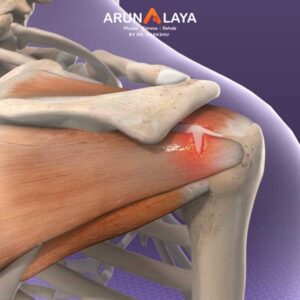
Rotator Cuff Tendonitis (or Tendinopathy) is an inflammation or irritation of one or more of the tendons of the rotator cuff muscles in the shoulder. These four muscles (supraspinatus, infraspinatus, teres minor, and subscapularis) form a “cuff” around the head of the humerus, providing stability and enabling a wide range of arm movements. Tendonitis typically involves microtears and inflammatory responses within the tendon tissue.

Causes of Rotator Cuff Tendonitis
Rotator cuff tendonitis is primarily an overuse or degenerative condition, stemming from repetitive stress or poor shoulder mechanics over time.
  • Repetitive Overhead Activities: This is the most common cause. Activities that repeatedly raise the arm overhead can pinch or rub the rotator cuff tendons (especially the supraspinatus) against the undersurface of the acromion bone (part of the shoulder blade).
    • Sports: Baseball (pitching), swimming, tennis, volleyball, basketball (shooting).
    • Occupations: Painters, carpenters, electricians, mechanics, construction workers, hairdressers.
    • Daily Activities: Reaching high shelves, washing windows.
  • Shoulder Impingement Syndrome: The most frequent underlying mechanism. It occurs when the space between the acromion and the rotator cuff tendons (the subacromial space) narrows, causing the tendons to be compressed or “impinged” during arm movements, particularly abduction (lifting out to the side) and flexion (lifting forward). Factors contributing to impingement include:
    • Bone Spurs (Osteophytes): Bony growths on the undersurface of the acromion.
    • Acromial Shape: Some individuals naturally have a more hooked or curved acromion.
    • Inflammation of the Subacromial Bursa: The bursa (fluid-filled sac) in this space can also become inflamed, further reducing space.
  • Thickening of the Coracoacromial Ligament.
    • Poor Posture: Rounded shoulders and a forward head posture can alter the mechanics of the shoulder joint, narrowing the subacromial space and increasing impingement risk.
  • Muscle Imbalances and Weakness:
    • Weak Rotator Cuff Muscles: If the rotator cuff muscles are weak, they can’t effectively depress and stabilize the humeral head in the shoulder socket, leading to it riding up and impinging.
    • Weak Scapular Stabilizers: Weakness in the muscles that control the shoulder blade (e.g., serratus anterior, trapezius) leads to abnormal scapular movement (dyskinesis), which can also narrow the subacromial space.
  • Age-Related Degeneration: As people age (typically over 40), tendons naturally become less elastic and less vascular, making them more susceptible to irritation and injury.
  • Acute Injury (Less Common for Tendonitis): A sudden fall or direct blow to the shoulder can sometimes cause acute tendonitis, but it is more commonly associated with tears.
  • Poor Technique: Incorrect form during sports or occupational tasks can place excessive stress on the rotator cuff.
  • Lack of Warm-up/Flexibility: Insufficient preparation before activity or poor general flexibility.
Symptoms of Rotator Cuff Tendonitis

The symptoms of rotator cuff tendonitis typically develop gradually over time and can range from mild discomfort to significant pain and functional limitation.

  •  Pain
    • Often a dull ache deep in the shoulder, which may worsen at night, especially when lying on the affected side.
    • Pain is aggravated by overhead activities, reaching behind the back, or lifting the arm out to the side.
    • May radiate down the side of the arm, but usually not past the elbow.
  • Weakness: Perceived weakness or difficulty performing activities that involve lifting, reaching, or rotating the arm. Actual muscle weakness may not be present in early stages but can develop due to pain inhibition.
  • Limited Range of Motion: Difficulty actively lifting the arm overhead or rotating it outwards. Passive range of motion is usually preserved or minimally restricted.
  • Clicking or Grinding Sensations: May be felt or heard during arm movement, particularly with rotation or elevation.
  • Tenderness: Localized tenderness when pressing on the specific affected tendon (most commonly the supraspinatus tendon, just under the acromion).
  • Stiffness: The shoulder may feel stiff, especially after periods of inactivity.
  • Painful Arc: Pain may be most prominent when raising the arm between 60 and 120 degrees of abduction (lifting out to the side).
Advanced Physiotherapy for Rotator Cuff Tendonitis

Acute Pain & Inflammation Management:

  • Ice/Cold Therapy: Applying ice to the affected area to reduce pain and inflammation.
  • Pain-Free Range of Motion: Gentle, controlled active and passive movements within the pain-free range to maintain joint mobility without stressing the inflamed tendon. Pendulum exercises are often started early.
  • Manual Therapy: Gentle joint mobilizations (e.g., glenohumeral, acromioclavicular, sternoclavicular joints) to improve joint play and reduce stiffness in surrounding areas that might contribute to poor mechanics. Soft tissue techniques to release tight muscles (e.g., pectorals, upper trapezius).
  • Postural Correction: Educating and exercising to correct rounded shoulders and forward head posture, which can significantly open the subacromial space. This includes strengthening postural muscles (e.g., lower trapezius, rhomboids, deep neck flexors).
  • Scapular Stabilization Exercises: Strengthening the muscles that control the movement and position of the shoulder blade (scapula). Proper scapular rhythm and stability are critical to prevent impingement during arm elevation. Examples: wall slides, rows, “Y,” “T,” “W” exercises.
  • Thoracic Spine Mobility: Addressing any stiffness in the mid-back (thoracic spine), as good thoracic extension is essential for optimal shoulder elevation.

Graded Rotator Cuff Strengthening:

  • Pain-Free Progression: Exercises are introduced gradually, starting with very light resistance and progressing as pain allows.
  • Isometric Exercises: Initial strengthening often begins with isometric contractions (muscle contraction without movement) in various shoulder positions, especially in abduction, external rotation, and internal rotation, to build strength without tendon gliding.
  • Concentric & Eccentric Strengthening: Progressing to exercises that involve muscle shortening (concentric) and lengthening (eccentric) against resistance. Eccentric exercises are particularly important for tendon healing and strength.
  • Specific Rotator Cuff Exercises: Targeted exercises for supraspinatus (e.g., “full can” raises), infraspinatus and teres minor (external rotation exercises), and subscapularis (internal rotation exercises).
  • Functional Strengthening: Integrating exercises that mimic daily activities (e.g., reaching, lifting) and occupational/sport-specific movements.

Neuromuscular Control & Proprioception:

  • Dynamic Stability Exercises: Activities that challenge the shoulder’s ability to stabilize dynamically, such as rhythmic stabilization (where the therapist applies small, unpredictable forces) or exercises on unstable surfaces.
  • Proprioceptive Training: Exercises to improve the shoulder’s awareness of its position in space, which helps with coordinated muscle firing.

Functional Rehabilitation & Return to Activity:

  • Activity-Specific Training: For athletes or individuals with demanding jobs, tailoring exercises and drills that simulate the movements of their sport or occupation. This includes proper throwing mechanics, swimming strokes, overhead lifting techniques.
  • Ergonomic Assessment: For work-related cases, evaluating the workstation and recommending adjustments to reduce strain.


BOOK AN APPOINTMENT


    Supraspinatus Tendonitis treatment in Delhi | Best treatment and cure for Supraspinatus Tendonitis relief | Achilles Tendinitis solutions Delhi NCR | Supraspinatus Tendonitis relief in New Delhi | Supraspinatus Tendonitis clinic Delhi | Supraspinatus Tendonitis exercise and physiotherapy | Supraspinatus Tendonitis specialist Delhi